Drabya Shah Multiple Campus

|
|
Drabya Shah Multiple Campus |
|
|
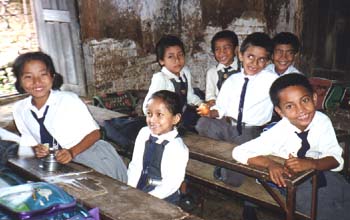
Education is the key to all progress, and the Nepali are keen to raise their standards in this field. In Nepal, education is provided for all children (other than those in very remote areas) but not every family can afford this luxury. Tuition is free from 5-16 years, although money is needed for admission and exam fees, books, stationery, uniform etc. In many cases the children are needed at home to look after the younger siblings, or to work in the fields. In school, most lessons are taught directly from textbooks, and the children have to repeat phrases back to their teacher. There is little or no practical work of any kind. Consequently, life in school is very dull for many pupils. Efforts have been made to brighten up lessons. For example, a Japanese group set up a science lab in a large rural school and volunteers showed the teachers how to use it. However, pupils are still taught from textbooks and the equipment is not used despite other volunteers efforts to encourage practical work in science lessons. I sent more than a ton of books to Gorkha for the Drabya Shah Campus, and for some schools in the area. A library was set up in the Campus, the Campus Chief and our volunteers have tried to encourage the students to use it to the full. In the schools, teachers often do not see the use for reading anything but textbooks, as they consider that this is all that is needed in order to pass exams. Education for interest only is not considered to be important. However, children were put in charge of their little library and they have become avid readers. A knowledge of English is essential for the development of Nepal. At the moment, it is often taught by teachers who only have a sketchy idea of the language. Grammar will not help if the understanding is lacking, but the teachers are keen to develop their skills in the English language. Our volunteers will continue to work with their Nepali counterparts, to exchange ideas and give help where needed. They enjoy teaching Nepali children, because they are eager to learn, friendly and co-operative. The rewards that the volunteers derive from teaching are such that many return to continue their work when funds permit. Joy leighton
August 1998
|
|
Information and Comments please e-mail info@leighton.org |